Showing posts with label Beatrisa Liang. Show all posts

Friday, January 1, 2010

2010 U.S. Figure Skating Championships Ladies Preview Part II


Emily Hughes


Expectations Going In: The 20-year-old Great Neck, New York native is best known for being a last-minute replacement for Michelle Kwan at the 2006 Olympics, where Hughes would finish the competition in 7th place. The following year, Hughes followed up that career breakthrough with silver medals attained at both the U.S. Championships and the Four Continents Championships. However, Hughes's skating began to fizzle out thereafter, and she wound up withdrawing from the 2008 and 2009 U.S. Figure Skating Championships. Hughes later announced that she would take the year off from attending Harvard to focus on her efforts of making a second Olympic team. While a loss at the North Atlantic Regionals was not part of her plan, Hughes was invited to compete at Skate America when Sasha Cohen withdrew. Hughes's short program was a relative disaster, but she improved her standing in the free skate by four placements to finish 7th overall.


Pros: Hughes is one of only four women scheduled to compete in Spokane who has the experience of competing at a U.S. Championships in an Olympic year, and she is one of only two women entering this event with Olympic experience. The 2006 Olympian is consistently capable of taking off from her lutz and flip jumps from the correct edge, something very few of the other U.S. ladies can say. Hughes demonstrates commendable flexibility in her spins and spirals, and she is currently showing a more mature style in her long program to the soundtrack from the motion picture Gone with the Wind. Hughes also skates with a creditable amount of speed, and 1998 Olympic gold medalist Tara Lipinski commented that Hughes's work with a ballet coach has helped the 2007 U.S. silver medalist create more defined movement in her choreography.


Cons: Hughes's jump rotation speed is slow when compared to her adversaries, and such a weakness causes her jumps to be under rotated frequently. Even while at the athletic peak of her career (2006-2007), Hughes was prone to under rotating jumps, and her more mature body certainly doesn't help her in this endeavor. Trouble with rotating triples continued at Skate America, where her triple flip in the short and her triple salchow in the long were only credited as doubles. Hughes's reputation has certainly waned in the last couple of years, as evidenced by her relatively low PCS marks at Skate America: a 23.76 in her short and a 46.64 in her long. While her programs have potential, they appear disjointed at the moment, and Hughes is going to have to find ways to connect dots of her program far better than what she is doing now to raise her PCS. An example of this can be found in her long program,  where Hughes does a spiral in the middle of the program. The spiral would be a very nice transition if done shortly before a jump, but Hughes takes so much time to pick up speed and prepare the jump that the overall effect of the movement is lost. Hughes is also known to not have the most steady landing positions: commentators frequently state comments like "She fought for the jump" or "She hangs on," but seldom do they ever say that she outright nails a jump.


Outlook: The Hughes family was blessed with the miracles of Sarah winning Olympic gold and Emily getting to go to the Olympics after Michelle Kwan withdrew, but it will take an even greater miracle than those two for Emily Hughes to make a second Olympic team. Even when adding back all of the marks Hughes lost for negative GOEs, downgrades, and popped/doubled jumps at Skate America, Hughes would have only scored around a 56.06 for her short and a 101.39 for her long. Her short program score would not put her at too much of a disadvantage, but her long program, even with a clean skate, would be easy to surpass for many. One thing that is in Hughes's favor, however, is experience. While Hughes is one to be sluggish during Grand Prixs, she typically is one to deliver at least decent performances at major events later in the season. Hughes has time to improve since Skate America, and she will probably be in better shape for nationals. With little reputation to bank on, however, Hughes will need to make the Olympic team, or any team, the hard way.


Beatrisa Liang


Expectations Going In: Liang appeared to have all the promise one could ask for when she competed at her first U.S. Figure Skating Championships on the senior level in 2001, all the while being just 12 years old. Unfortunately, the 21-year-old Tarzana, Los Angeles native has never fulfilled that early promise, aside from a few career highlights (pewter medalist at the 2007 U.S. Championships, 10th place at 2008 World Championships). Liang's career appears to be spiraling downward more than ever, as she placed 14th at this event last year and was 10th out of 11 skaters at this year's Cup of China. Thus, not much is expected of what could be Liang's final competition.


Pros: The 2006 Four Continents bronze medalist moves extremely quickly while doing anything: jumps, spins, stroking, et al. She achieves decent height on her triples, and she has some of the better spins among the current crop of American ladies skaters. Liang is also one of the most experienced U.S. ladies skaters who are currently competing: she has competed in 11 national championships and nine of them on the senior level. Liang has improved her extension over the years and is one of the few to repeat the lutz and flip jumps - the two hardest jumps besides the axel -  twice in her long program. Liang has finished in the top five four times at the U.S. Championships.


Cons: A 62.93 is considered a very good score for a short program. Although, with the 76+ totals that Yu-Na Kim often receives, the score would be unlikely to top a leader board going into the free skate of a World Championship or Olympic Games. However, Bebe Liang received a 62.93 for her free skate at the Japan Open back in October for a humiliating free skate that contained zero clean triples. Poor, desolate performances from Liang last year dropped her to 14th place, and her 10th place finish from Cup of China was even scarier, as she had the potential to skate much worse than she did. Liang received edge calls on each of the three triple lutzes she attempted at Cup of China, and she also had three triple jumps downgraded in her long program there. Artistically, Liang's transitions are not optimal and her choreography in her current programs is fairly elementary when stacked up against the top U.S. women.


Outlook: It is more likely that pigs will start flying than it is for Liang to make the 2010 Olympic team. Liang had a decent chance of making the 2006 Olympic team, but she blew it when she succumbed to the pressure in the long program by falling twice. She made the most out of her time at what will likely be her only World Championship in 2008, where she cracked the top ten with two decent skates. Since then, however, Liang's skating has gone south and it is unlikely that she will continue beyond this season. Liang is no longer age-eligible to compete at the World Junior Championships, and the Four Continents Championships are scheduled for the week immediately following the ladies competition at Nationals, thus making it questionable as to whether there will be any American representatives in the ladies event there. With all of that said, Liang's last competition may very well be this one, and with the way she has been skating lately, she won't go out with a bang.


Mirai Nagasu


Expectations Going In: The 16-year-old Montebello, California native came out of nowhere to beat heavy favorite Caroline Zhang for the junior title at the 2007 U.S. Championships. Nagasu appeared to be the next great U.S. skater when she surprisingly won the 2008 U.S. Championships as a senior, becoming the second youngest U.S. senior ladies champion in history (Tara Lipinski being the youngest). Unfortunately, a massive growth spurt and an ankle injury severely hindered Nagasu's efforts in the 2008/2009 season, and she has since switched coaches from Charlene Wong to Frank Carroll. Thus far this season, Nagasu has neither helped nor hurt her Olympic bid, but she is still considered a very viable contender for a ticket to the Games.


Pros: Nagasu has superb extension and shows that off to its fullest in her exemplary spins and spirals. Nagasu's growth spurt has enabled her to become much faster across the ice, and her long, lean frame presents viewers with a very attractive body line to watch. Nagasu won the short program at this season's Cup of China with a score of 62.20, a short program total which has only been surpassed by four women in ISU competition this season. Also, the two-time Junior Worlds medalist is prone to peaking at Nationals, as she won the junior title in 2007 and senior title in 2008. Also, even though Nagasu did not medal in 2009, her overall showing there was far superior to her performances at her two Grand Prix events earlier that season. Nagasu showed to be a formidable competitor last year, when she arrived to her free skate in tears and admirably finished her skate without major error. Nagasu has always been marked favorably by the U.S. judges: in 2008, she broke 70 points for her short program and placed above Caroline Zhang's clean long program with a free skate that contained a fall and an under rotated jump.


Cons: Nagasu has always had a huge tendency to flutz, but at Skate Canada, she was given an edge call for her flip in the short and both of her lutzes in the long. Nagasu had four triples and one double jump downgraded during her free skate at Cup of China, and she also received downgrades on two double jumps at Skate Canada. Nagasu's PCS marks went down from Cup of China to Skate Canada for both programs, and while she rotated all of her triples during her long at the latter event, her expression and overall artistry suffered immensely. Nagasu has taken the salchow jump out of her repertoire, and she only attempted five triples in her long at Skate Canada. Two of those triples were lutzes, which are often taken off from the wrong edge or under rotated, and another was a flip jump, an element which was downgraded twice at last year's Nationals. Several of Nagasu's comments that she made at the U.S. Olympic Media Summit about her not being very pretty or very smart, while honest, indicate that Nagasu's confidence level is precarious at best.


Outlook: Nagasu's fall international season has lagged behind those of Czisny, Flatt, and Wagner; however, her scoring potential and ability to peak at nationals make her chances to make the Olympic team very realistic. What should decide Nagasu's fate will be her ability to rotate jumps. Even though the execution judges are no longer required to give a downgraded jump a -GOE, under rotated jumps are still very costly under the new scoring system and will tarnish any advantage Nagasu would have on the second mark. Luckily for Nagasu, Czisny and Wagner have frequently had jumps downgraded as well, and Nagasu receiving full credit for her planned five triples at Skate Canada is certainly a step in the right direction. Nagasu has scored well domestically, and she will be difficult to unseat for an Olympic berth if she goes close to clean in Spokane. However, a meager difference in the rotation of a jump can put a lifelong dream on hold.


Ashley Wagner


Expectations Going In: Wagner burst out onto the scene as a senior level skater in the 2007/2008 season when she took home a bronze medal at the U.S. Championships. Battling injury, pressure, and the unenviable task of following Miki Ando (who withdrew during the beginning of her skate due to an injury), Wagner only finished 16th at her only World Championship thus far. The 2008 U.S. bronze medalist decided to change coaches from Shirley Hughes to Priscilla Hill in 2008, and while Wagner didn't make the world team last year, her coaching switch appears to be paying off with two medals on the Grand Prix this season and a 4th place finish at the Grand Prix Final. Wagner appears to be the favorite to take the second Olympic ticket (behind Rachael Flatt), but with Czisny and Nagasu nipping at her heels, Wagner cannot attain an Olympic berth without two creditable performances.


Pros: The change in Wagner's artistry since moving to Priscilla Hill is night and day, and the two-time World Junior bronze medalist has two strong, dramatic programs this season to showcase that improvement: a short to the soundtrack of Once Upon a Time in America, and a long to the music of "Polovtsian Dances." Wagner is one of the most complete U.S. ladies skaters, boasting strong jumps, spins, speed, and musicality.  Wagner was the only U.S. lady to qualify to the Grand Prix Final, and a 4th place finish there should help her out politically heading into Nationals. Wagner won the long program at last year's U.S. Championships with only five clean triples, and she placed ahead of Rachael Flatt and Caroline Zhang, who both landed six triples. Wagner was the only U.S. lady to medal in both of her Grand Prix events this season, and she set personal bests at the Rostelecom Cup for both her long program and her overall segment total. Wagner stated on her Facebook account that she is "plugging away at those triple-triples," and Priscilla Hill insisted in a New York Times article that Wagner was far from her optimum form during the Grand Prix season.


Cons: Wagner has yet to kick her flutz habit to the curb, and out of six attempts at that jump during this season's Grand Prix she received one "!" and five "e" edge-calls (and the "e" edge-calls are the more severe of the two). She is also a skater to often under rotate jumps, and no jump is immune from being downgraded for Wagner. The current U.S. pewter medalist has had not one, but two, double axels downgraded this season, and she also has received two downgrades on her second triple flip in the long program. Wagner puts a triple lutz late in the long program, which she often receives a -2 GOE for, even if otherwise done cleanly, instead of doing an easier triple toe that would give her around the same point value. The same logic could also be applied to her short program, where the substitution of a loop or salchow for her lutz would likely augment her score. Also, Wagner's plans to do a triple-triple backfired last year, and she has not competed one cleanly since 2008 Nationals. Wagner's PCS went down in the long program from NHK Trophy to the Grand Prix Final, with her GPF free skate being far superior to her one executed at NHK.


Outlook: For better or for worse, Wagner certainly has confidence, going as far as to imply that she could surprise and win the Olympic Games in a New York Times article. Wagner has easily been the second best skater in the long program this year, but Czisny should have an advantage with her short program if Wagner's flutz remains intact. It is worth mentioning that the U.S. technical specialists tend to be more lax with edge calls and have been so to Wagner's lutzes in the past: in 2008, Wagner received no edge call for any of her three lutzes, and she only received an "!" for one of them in 2009. However, the U.S. technical specialists were not shy at Nationals last year when it came to downgrading jumps, which is something that could make an attempt at a triple-triple unwise. Scott Hamilton did mention during his commentary at the Grand Prix Final that Wagner should increase her difficulty, but cleanliness might be the best route with top rivals such as Czisny and Nagasu bound to make errors somewhere. Wagner has been neither brilliant nor dreadful this season, but she has been reasonably solid across three competitions. Adding that with a 4th place finish at the Grand Prix Final should ensure Wagner of the ability to control her own destiny at the U.S. Championships, as she has been marked well at this event in the past with less credentials entering in.


Caroline Zhang


Expectations Going In: Like Nagasu, Caroline Zhang was considered a budding talent whilst on the junior ranks, as evidenced by her taking home the gold medal at the 2007 World Junior Championships. Her first experience on the senior Grand Prix went well, and she took 4th place at the 2007 Grand Prix Final with an overall score that has not since been matched by a U.S. lady in ISU competition. Zhang was too young to qualify to the senior world team in 2008, but she became eligible in 2009 and just missed a spot on the team. Many felt that she should have been on the world team with her impressive performances at both the 2009 Four Continents Championships and the 2009 World Team Trophy. Since then, however, Zhang has not indicated that she will skate well enough in Spokane to be at all deserving of an Olympic berth.


Pros: Arguably the most flexible skater in the world, Zhang is renowned for her six o'clock spirals and her stunning "pearl" and Bielmann spin positions, as she frequently receives high levels and GOE through the roof for her spins and spiral sequences. Zhang delivered near clean long programs at both the 2008 and the 2009 U.S. Championships and is one to perform near her optimum in the later part of the season. Zhang's new short program to "Zigeunerweisen" showcases a fire and intensity that has been missing from several of her previous programs. Zhang's personal best in her long program, a 116.80, has only been surpassed by one of the ladies set to compete in Spokane, Sasha Cohen. Zhang also has a full arsenal of triples besides the axel and will likely be one of the only women attempting triple-triple combinations in Spokane.


Cons: Zhang didn't perform terribly at her opening event of the season, Trophee Eric Bompard, but her PCS marks went down considerably from when she had last competed at the World Team Trophy. Zhang would go on to miss the podium at that event and finish 4th, but the worst was yet to come. At Skate Canada, Zhang had the worst long program of her career as a senior level skater, scoring only 77.88 for a performance of which contained two falls and an invalid jumping pass. Zhang's poor speed, transitions, and overall artistry were reflected brashly in the judges' marks, with one judge going as far as to give Zhang a 2.5 for transitions. Zhang has not had much political favor domestically, and her fall international showing will certainly not aid her in that regard. Zhang landed six triples in her 2008 and 2009 Nationals free skates, but both times she only finished 4th in the long program phase of the event. Zhang has said to be incapable of breaking out of her comfort zone, and it certainly appears to be that way with so many of her weaknesses including her flutz, mule kick, poor stroking, lack of transitions, and molasses speed showing little or no improvement from when she was on the junior level.


Outlook: Zhang's season appears to have been doomed from the start, with two coaching changes and a partial tear of her ACL occurring over the summer. Zhang had a pitiful outing at Skate Canada, but she has shown a fighting spirit several times in the past and should improve for nationals; however, even a dramatic improvement will mean nothing for Zhang's nearly non-existent Olympic chances. The U.S. judges have never scored Zhang beneficially and certainly won't start doing so with her poor Grand Prix season. Zhang will still be much in the running to earn a 4th ticket to what is perhaps a painfully familiar event for her: the World Junior Championships. Zhang's poor technique on just about every jump (except the salchow, which interestingly she never did throughout much of 2007-2008) and her poor speed going into those jumps will hold Zhang back forever unless if major changes are to be in order. Zhang did grow taller last year, yet she interestingly dealt with all of her technical issues well (for the most part). Unfortunately, it appears as though an injury and a further growth spurt have expired Zhang's success with her many technique foibles. Zhang is incredibly talented and can make a splash come 2014, if she does something she has never done before: break out of her comfort zone.


Predictions


Gold: Rachael Flatt- Flatt should start winning respect from the U.S. judges after her excellent showing at Skate America. If Cohen is not to come back and Czisny remains a headcase - both of which appear likely - Flatt will be the United States' only hope for a ladies medal in Vancouver.


Silver: Ashley Wagner- If the U.S. judges are lax with edge calls, Wagner will be in very good stead to make her first Olympic team. Still, the two-time Junior World bronze medalist would be wise to arrange her jump layouts in such a way that she wouldn't have a try the jump in either program. Triple-triple combinations are great if they're landed (or even just rotated), but they could be unnecessary, or detrimental, to Wagner's Olympic bid.


Bronze: Alissa Czisny- Quite an irony this would be if Czisny were to finish 3rd after basically losing the third spot for the United States in Los Angeles. The judges would look terrible if they blatantly prop up Czisny as they did last year, but she still should be marked favorably with a decent fall international season behind her. However, Czisny cannot go clean in both programs to save her life, and an Olympic ticket on the line won't help her out at all in that endeavor.


4th: Mirai Nagasu- She should perform at least decently here considering her past nationals showings, but downgrades always plague her and could cost her dearly at this event. Nagasu's PCS have been fine domestically, but have not been so fine internationally this season. Thus, it will be interesting to see if her lower PCS marks (especially comparative to Czisny's) at Skate Canada will show up at Nationals.


5th: Caroline Zhang- Has no where to go but up after her performance at Skate Canada, and she has delivered good skates at the past two U.S. Championships. All of that won't mean anything, however, because the judges won't be on her side.


6th: Christina Gao- She has good jumps, very good jumps, and not much else. Still, Brian Orser and his assistants are absolutely heading Gao in the right direction, and she is in the position to have a very admirable showing at these Championships.


7th: Emily Hughes- She had an adequate outing at Skate America on short notice and should display relative improvement for this competition. Under rotated jumps will be a major factor in her placement, but Hughes is experienced enough to get decent PCS and avoid cleaning the ice here.


8th: Alexe Gilles- She is a fairly elegant skater but her jumps are quite often not there for her. She had a fair showing last year and will hopefully take that experience to perform well again.


9th: Bebe Liang- She generally manages somewhat decent showings at nationals, but top ten will probably be the highest realistic goal for her after her poor finish last year and her rough outings in the fall.


WD: Sasha Cohen- Her injury situation was dire enough to pull her out of an event with a weak field and little at stake at Skate America. Recent videos from the show "Improv Ice" show Cohen struggling with one of the easiest jumps, the salchow. Perhaps we may be lucky enough and see Cohen show up in Spokane to do a short program and then mysteriously bow out prior to the long.

Saturday, December 19, 2009

2010 U.S. Figure Skating Championships Ladies Preview

Two years ago at this very competition, the talent pool for U.S. ladies figure skating appeared limitless. There was Mirai Nagasu, the winner of the event who scored an eye-popping 70.23 points for her short program. Then there was silver medalist Rachael Flatt, who landed ten triples throughout the course of the competition, bronze medalist Ashley Wagner, who displayed a rare triple lutz-triple loop combination in both programs, and 4th place finisher Caroline Zhang, who skated an excellent long program while still finishing outside of the top three. Unfortunately, an age rule preventing Nagasu, Flatt, and Zhang from competing at Worlds meant that U.S. Figure Skating would be represented by the then immature Wagner, the interminably error-prone Beatrisa Liang, and the confidence-stricken Kimmie Meissner. Not surprisingly, the U.S. ladies failed to earn three berths for the following year's World Championships. The ladies' prospects for the 2009 World Championships hardly looked better, and the result was no different. Alissa Czisny managed to splat her way to win the 2009 U.S. title in controversial fashion, and she would splat once again, twice in fact, in her short program at the 2009 World Championships. Czisny would eventually finish 11th, while compatriot Rachael Flatt fared better to finish 5th; however, no U.S. lady had proven to have the technical and artistic gifts to realistically vie for a medal, and certainly not a gold, on a premier international stage.


Enter Sasha Cohen. The 2006 Olympic silver medalist was supposed to save the day; she was supposed to be the solution to win a medal at the Winter Games, or, at the very least, to ignite increased exposure for the Olympics that would not be existent otherwise. Fans around the world, perhaps delusionally, thought that this comeback effort would be brilliant. Cohen was looking fit on tour. Cohen was supposedly practicing triple-triples. Cohen was going to be coached by task master Rafael Artunian. Cohen was going to rearrange her "Moonlight Sonata" program that was so lauded on tour. Now, Cohen is merely attempting to save her own comeback from amounting to nothing. Cohen is on her third strike now, having withdrawn from TEB and Skate America, but it is still debatable over whether Cohen will even attempt to step up to bat in January.


While Cohen has been out of it, several of the U.S. ladies have been faring much better. Rachael Flatt beat current World Champion Yu-Na Kim in the free skate at this season's Skate America, and Flatt didn't even receive credit for her final spin combination. Ashley Wagner pulled off an impressive 4th place finish at the 2009 Grand Prix Final. Alissa Czisny has even managed to skate several clean short programs this year, and she won a silver medal at this season's Skate Canada. Mirai Nagasu's season has not been brilliant, but even she won the short program at the 2009 Cup of China. Cohen certainly has an uphill climb to make the Olympic team while planning to compete for the first time in nearly four years, but it is still not out of the question for her to do so if she is to miraculously become fit, healthy, and peaked for nationals. Despite what the selection procedure states about Olympic team results being decided on multiple events, all does come down to the results of the 2010 U.S. Figure Skating Championships. The training has been arduous; the pressure, intense; but the rewards of earning the right to compete at the Olympics speak for themselves. After January 23rd, 2010, two women will be able to call those rewards their own.


Skaters Featured in Post

Sasha Cohen
Alissa Czisny
Rachael Flatt
Christina Gao
Alexe Gilles

Emily Hughes
Beatrisa Liang
Mirai Nagasu
Ashley Wagner
Caroline Zhang


Red indicates commentary of skater is featured in part one of preview
Blue indicates commentary of skater is featured in part two of preview


Sasha Cohen


Expectations Going In: Cohen enters this event as the true enigma of the championship. The 25-year-old Laguna Niguel, California native’s programs have yet to be shown in their entirety, fans haven’t even seen her jump since a show at the beginning of October, and her injury - tendinitis in her calf - was first thought to be a sham. Cohen's injury was serious enough to keep her out of Skate America, which was host to a very weak ladies field (with the exception of Kim and Flatt). The blog "Aunt Joyce's Ice Cream Stand" reports that Cohen is continuing to struggle in training. Hence, few of Cohen's fans are so hopeful any longer, and it would be surprise to many just to see Cohen board a flight to Spokane in January.


Pros: Cohen's artistry far surpasses that of any of the U.S. women competing today. The two-time Olympian has supreme musicality and interpretation, qualities which were the prime reason why she won the 2006 Olympic silver medal and World Championship medals in 2004, 2005, and 2006. Armed with legs that extend to tomorrow, beautifully shaped feet, and a supple back, Cohen is one of the most limber athletes to ever compete in figure skating, with such flexibility allowing her spin and spiral positions to be nothing short of brilliant. Cohen has long been scored favorably both domestically and abroad, and the judges marked Cohen well at the 2006 Olympic Games, despite her having two major mistakes in her long program. ISU head Ottavio Cinquanta commented upon the announcement of Cohen's return that "Now we can have the Sasha Cohen era as a strong skater with more experience," and that "It is a good decision for the ISU and her." Statements such as those suggest that Cohen is still favored politically even after having not competed for years. U.S. Figure Skating, void of having a star in the ladies event since Cohen's departure from the sport, should feel no differently toward Cohen if she is to skate well in Spokane.


Cons: Cohen is a habitual flutz offender and will likely receive wrong-edge deductions for that jump that she did not receive during and before 2006. Cohen has yet to skate a clean long program at a U.S. Championships, World Championships, or Olympic Games. Cohen's injury situation is obviously dire- or at least it was a month ago - because her old form would have had no issue medaling at Skate America. Recent returns to competition after injury from Patrick Chan, Stephane Lambiel, and Daisuke Takahashi haven't exactly been smooth, and they weren't away from competition as long as Cohen, nor were they making their return to events with as much pressure as what Cohen will face in Spokane. Debuting programs and testing out jumps for the first time with an Olympic team berth on the line will be a daunting task for the 2006 U.S. Champion, who has never been an especially brilliant competitor or jumper, even while at her athletic peak. The other U.S. ladies have had time to test out their programs, get feedback on them, and to rearrange jump layouts if necessary; Cohen, however, has none of those luxuries entering this event.


Outlook: Even though Cohen is planning on making her return to a competition that is essentially an Olympic trials, she really has little to lose if she is to perform poorly here, provided she doesn't risk further injury. Cohen has already competed at two Olympics and won a medal, and a failed comeback won't be the first thing that defines Sasha Cohen to people in the skating community after all of this is said and done. After all, Cohen has commented that she misses the fire and intensity associated with competition, and what better way to experience that than at a national championship in an Olympic year. It is unknown how much or how little Cohen will factor in at this event, or if she will even make an attempt to factor in at all. Cohen would be the first lady in 74 years to make a third U.S. Olympic team, but the 2006 Olympic silver medalist's efforts to make that happen have likely been too little, too late.


Alissa Czisny


Expectations Going In: At last year's U.S. Championships, Czisny was one of four athletes (Flatt, Wagner, and Zhang being the other three) favored to make the world team. Out of the four, Czisny was chosen as the judges' favorite and she became national title in an extremely controversial result. Czisny only managed to land three clean triples in her long program, yet she placed above Caroline Zhang, who landed six triples, in that portion of the competition. USFSA's tactless and peculiar propping up of Czisny backfired when the reigning U.S. Champion continued upon her head case ways, as she fell twice in the short program at the World Championships en route to an 11th place finish. A disappointing outing in L.A., however, didn't seem to hinder Czisny's confidence badly in the least. Czisny won a silver medal at Skate Canada, and while she has met with trouble in several of her long programs this year, her short program has been successful competition after competition. Czisny is not favored to repeat as champion, but she does still make a strong case for the second Olympic berth.


Pros: Czisny is one of the world's most exemplary spinners, spinning faster than a tornado while maintaining immaculate positions. The two-time world team member has always been noted for her artistry and maturity on the ice, and she has two great programs to showcase that this year: a short program to Mask of Zorro and an improved revival of last year's long program to Dr. Zhivago. Her current programs have been well received by the international judges, as evidenced by Czisny having the highest average PCS score in the long program among all of the U.S. women this season. Czisny is one of the few U.S. ladies consistently capable of taking off of an outside edge whilst attempting a lutz jump, and she is also one of just a handful of skaters to ever perform a Charlotte spiral. Czisny has skated near-clean short programs at every competition she has skated in since the 2009 Worlds, and her SP score of 63.52 at Skate Canada has only been bested by current world medalists Yu-Na Kim, Joannie Rochette, and Miki Ando so far this season.


Cons: Czisny was coming into the 2006 U.S. Championships as one of the favorites to claim an Olympic berth after she had qualified to the Grand Prix Final. Instead, Czisny would fall five times throughout the course of the event and finish the event in 7th place. Czisny has taken much effort to improve her jump technique and her consistency in competition, whether it be attending numerous competitions throughout the summer or working on her jumps with Brian Boitano and his former coach, Linda Leaver. Czisny has improved, but her nerves are still bound to fail her at inopportune times. Czisny fell once in her long program at the Rostelecom Cup and twice in her long at Skate Canada, and she had nine triples downgraded between Nebelhorn and her two Grand Prixs this season. Czisny has not received full credit for a triple loop at an ISU event this season, and she does not attempt a triple salchow jump. She also has a tendency to take off of her triple flip from an outside edge, thus incurring an additional penalty.


Outlook: One shouldn't expect the judges to prop up Czisny like they did last year - particularly if Cohen competes - but she has been marked well internationally this season and her always favorable marks at the U.S. Championships should continue to come. The two-time U.S. medalist has been upgrading her jump content, as she has added both a double axel-double axel sequence and a second triple loop to her long program jump layout. She would be wise to scale back her second loop to a double axel, as her triple loop consistency from last season has vanished. Czisny should go for a safer jump layout because her PCS, spins, and spirals will be enough to cushion her over Ashley Wagner, who lacks Czisny's finesse and doesn't have as high a scoring potential in the short program. Czisny's consistency with short programs has been impressive this year, and continued solidity there should allow her to be ranked first or second after that phase. However, Wagner can surpass her in the long program if Czisny's downgrade woes continue. Czisny's chances for actually repeating as champion of the United States are low, as Rachael Flatt certainly has picked up much momentum after Skate America. Czisny should still have an advantage over Flatt with PCS, but likely not as much as before, and Flatt's jumps should have no issue making up any ground on the second mark. Czisny's case for making the team via the second spot is by no means assured; however, she is a strong enough skater to control her own destiny toward securing that ticket.


Rachael Flatt


Expectations Going In: The 17-year-old native of Del Mar, California, won the U.S. silver medal in 2008 and 2009, both competitions of which some felt she should have won. Too young to qualify in 2008, Flatt made her first trip to the senior worlds in 2009, where she took full advantage of others' mistakes to finish in the top five. Her 2009/2010 season started off abruptly with a weak showing at the Cup of China, where she finished 4th, but the disappointment of that event was erased with a strong second place finish at Skate America, where she landed seven triples in her long program and beat Yu-Na Kim in that phase. Although Flatt narrowly missed qualifying to the Grand Prix Final, she does enter her fourth U.S. Championships at the senior level as the favorite.


Pros: Flatt marked a personal best score of 116.11 for her long at Skate America, which is the highest long program mark attained by any American lady this season by over seven points. Flatt attained the score even though her final spin combination did not count, and her long program and overall segment scores from that competition have only been bested by five women thus far this season. The reigning U.S. silver medalist has improved several aspects of her skating for this Olympic season, including her presentation to the audience (best evidenced in her short program to "Sing, Sing, Sing") and her lutz, which received no edge call at Skate America or Cup of China. Flatt has skated cleanly (minus a downgrade on her triple-triple last year) at the last two U.S. Championships and is easily the most consistent jumper among the top American women.


Cons: Flatt has a very awkwardly proportioned body and it hinders parts of her skating such as flexibility and posture. Flatt is routinely criticized for her lack of speed and this weakness continues to be very much on display during her long program to "Rhapsody on a Theme of Paganini," where Flatt gets little power in her stroking during the later part of the program. Flatt's posture is considerably hunched over, and she thus doesn't have great usage of her upper body as she skates. To top that off, several of Flatt’s spin positions are less than desirable, with her catch-foot spin being particularly poor. In regards to political favor, Flatt has not received the benefit of the doubt at the last two U.S. Championships. In 2008, Flatt went to skate a clean short that contained a triple-triple, but she only finished third in that phase and was over seven points behind Nagasu. In 2009, Czisny's short program scored over five points higher than Flatt's short (with both skating programs with similar content and execution) and Czisny's three-triple long program only placed a little over a point below Flatt's six triple long program at that event. Flatt's PCS score during her long at those U.S. Championships was also only the 5th highest of the night for a basically clean skate, and she scored over seven points back of Czisny on that mark.


Outlook: Flatt was nearly 18 points away from the bronze medal at the World Championships, but the international judges are warming up to her and with Cohen's comeback woes, Czisny's jump issues, and Wagner's inconsistency, Flatt looks to be the only American woman with even a remote shot of contending for an Olympic medal. The judges can arrange the marks how they want to, but Flatt has marked over 116 for a long program when Wagner's best is under 109 and Czisny and Nagasu are struggling just to break 100. Slow, mundane, boring, flat, whatever you want to call her, Flatt is more and more looking like the top American woman and the U.S. judges ought to recognize that and favor her instead of favoring someone else who will diminish the need for a Zamboni. With the results of the 2009 Worlds and Skate America, Flatt's PCS should increase for the U.S. Championships, and she should be looking at a first U.S. title and a ticket to Vancouver if she arrives as fit to Spokane as she has for the past two years at this event.


Christina Gao


Expectations Going In: Gao is not a contender for the Olympic team, but she could make a case for either the Four Continents team or the Junior Worlds team if she continues her rapid improvement under the tutelage of Brian Orser. Gao will be entering her first U.S. Championships on the senior level after finishing third last year on the junior level. She bested Canadian Cynthia Phaneuf during the long program at a competition in Quebec last summer, and she won three bronze medals this year on the Junior Grand Prix circuit, including one of them that was attained at the Junior Grand Prix Final.


Pros: Gao scored personal bests in both phases of competition at the Junior Grand Prix Final, and she completed all of her planned triple jumps successfully. Gao has both a high jump and a quick head spot, which enable her to rotate her triples consistently. Brian Orser's magic as a coach is clearly rubbing off on Gao, who has gone from being the third ranked junior skater at U.S nationals last year to becoming the top U.S. finisher at the Junior Grand Prix Final. Gao has the 7th highest seasons best among the U.S. ladies, and she was credited with landing six triple jumps at the Junior Grand Prix Final, something that Czisny, Nagasu, Wagner, and Zhang have yet to do in an ISU competition this season. Gao can also be lauded for her ability to go outside the box with different music choices: she skates her short program to "Morning Passages" from the film soundtrack of The Hours and her long program is to the music of the ballet "La Fille Mal Gardee."


Cons: Gao is in desperate need of extension in her sit spins, spirals, and choreography. Gao lacks stylistic maturity and is not one to project and express herself to the audience. Her personal best score of 151.47 achieved at JGPF is solid, but even when adding in 3-4 points for a missing spiral sequence (as the juniors aren't currently allowed to have a spiral in their LP) and a possible score inflation, Gao would still have been 10-15 points back of placing in the top three at last year's U.S. Championships with clean skates. It is also worth mentioning that Gao's scores at her opening two Junior Grand Prixs were over 16 points lower than what she attained in Tokyo at the Final. Gao has an egregious flutz, and she doesn't appear to have enough speed coming out of her triple lutz or a strong enough toe-pick assistance on her double toe to upgrade that combination to a triple-triple. Gao will not only need to speed up to challenge the top U.S. women, but she will also need to augment her currently rudimentary choreography.


Outlook: Gao should be extremely proud of her improvement, as she went from scoring a 128.69 at last year's U.S. Championships to a 151.47 at JGPF in less than a year. Gao should have no issue breaking the top ten in Spokane and solid performances like those she produced in Tokyo could even break her into the top six. A strong showing at nationals should get Gao either a Four Continents assignment or a Junior Worlds assignment, the latter of which being more likely. Gao turns 16 in July 2010 and has a bright future ahead of her. She still has much room to grow and improve, but she has come a long way in the last year and should continue to do under the eyes of Brian Orser. Gao is blessed with a very ideal body for a figure skater, and she will hopefully fine tune her technique and artistry in the coming future to let her skating reach its fullest potential.


Alexe Gilles


Expectations Going In: Gilles appeared to be a possible dark horse for an Olympic team after winning the bronze medal at the Junior Grand Prix Final last season and placing 5th at Trophee Eric Bompard this year. Unfortunately, a 10th place finish at Skate America won't do well for Gilles's nerves, nor will it serve her in good stead in the eyes of the judges in Spokane. Gilles has a reasonable chance for a Four Continents or Junior Worlds assignment, but her prospects of making an Olympic or World Championship team are far darker than even a dark horse's.


Pros: Gilles has a charming, elegant presence on the ice, which she best shows off in her beautiful short program to Strauss's Cinderella. Gilles placed 2nd in TES and 4th overall during the short program phase of this year’s Trophee Eric Bompard. Gilles would go on to beat Carolina Kostner, Kiira Korpi, and Elene Gedevanishvilli to finish 5th, and Gilles was just 1.24 points away from taking 4th ahead of compatriot Caroline Zhang. Gilles is one of the only U.S. skaters who are consistently capable of taking off from the correct edge on her lutz, and she did not receive any downgrades for her triple jumps at TEB. Gilles gets nice height on her triples and is also solid in the other elements of her skating, as evidenced by her receiving level threes and fours for all of her non-jump elements (except one) throughout her two Grand Prix events.


Cons: Gilles doesn't have much of a reputation domestically or internationally, and her scores at both TEB and last year's U.S. Championships were both thought to be too low by many fans. Gilles has somewhat erratic jumps and it will be difficult with her 5'7" frame to be able to gain that consistency (just ask Carolina Kostner). Tara Lipinski also commented at Skate America that part of the problem that tends to give Gilles issues on her jumps is her lack of speed going into them. A lack of speed throughout Gilles's stroking and non-jump elements does impede her overall scoring potential sizably. Gilles is somewhat prone to lipping, as she received an "!" edge call for all three of her triple flip attempts at Skate America. Also, Gilles has relatively weak flexibility and has a particularly unflattering Biellmann position (if one could even call it that). The choreography in Gilles's programs is fairly elementary, as are her transitions preceding major elements.


Outlook: Gilles is a talented skater with a creditable sense of musicality and pretty jumps when they are on. However, she has quite a bit of room for improvement and will need to fill that if she is to ever make a World Championship or Olympic team. Gilles is actually fairly consistent with rotating jumps despite being so tall, but her timing has to be 100% precise to land the difficult triples considering her height. Gilles will need to skate faster in all of her elements: stroking, spins, spirals among them. Gilles also needs to add more difficult choreography and a triple loop entering her jump repertoire couldn't hurt either. Despite these weaknesses, Gilles's basics are there. Her edges are decent, she has nice square hips while approaching her flip and lutz jumps, and she does have an innate sense of musicality. Gilles is 17 and should thus have the next quadrennial to make these improvements if she chooses to continue skating. While Gilles may not be in Vancouver, it is very possible that she will be skating at several major competitions to come.

 
Part two to come shortly.

Friday, October 30, 2009

COC Ladies SP Commentary

Here is my commentary for the ladies SP which took place earlier today in Beijing. I am watching this event without knowing the results beforehand and this page will be updated as I see the competitors skate.

Skate Order:
Warm-Up Group 1
1.) Bingwa Geng (China)
2.) Binshu Xu (China)
3.) Yan Liu (China)
4.) Diane Szmiett (Canada)
5.) Beatrisa Liang (USA)
6.) Mirai Nagasu (USA)

Arena is about half full. Same arena as last year's Cup of China. Binshu Xu in pink top with blue skirt. Yan Liu in light blue. Szmiett in red; Liang in black; Nagasu in black and gold.

Liang looks a little out of shape but just landed a triple toe. Nagasu did a triple flip which looked slightly UR. Yan Liu stumbled out of her triple loop slightly.

Nagasu did a triple lutz with a slight fall out and inside edge takeoff. Liu (I believe) did a 3Z at the end of the warm-up.


Bingwa Geng (China)
Purple dress
Looks like a young Caroline Zhang, and is skating to Meditation from Thais
3S-good steps before, entrance was long but the jump had great height and a good landing
3Z-fall out, +1T-won't get credit for 2nd jump, put her foot down in-between, takeoff edge looked clean
2A-lovely
spiral-extension is good, not great
Footwork-nice
Good donut spin
Layback position is too turned in but her Bielmann is great
Nice ending pose
She will get marked down quite a bit for her mistake on the triple lutz but otherwise a very nice performance. Geng could be a legitimate contender at major competitions in the future. Good choreography, nice use of arms, and did express herself well in places.

TES: 28.20
PCS: 19.44
Total: 47.64
PCS are a little low IMO but scores at this event were rather tight last year.


Binshu Xu (China)
3T-fall; likely UR
3S-solid; slightly UR
spin combo-good speed; weak positions on layback and Bielmann
spiral-extension is decent; skating edge is very wobbly
2A-nice
last spin combo-good speed but traveled
Very weak projection to the audience.

TES: 19.36
PCS: 18.72
Ded: -1.00
Total: 37.08
Rank: 2


Yan Liu (China)
IIRC the same as last year's SP
3Z+2T-a little slow coming out of 3Z and possibly flutzed; otherwise clean
3R-good
Rough transition from standard spiral to catch-foot spiral
2A-coming after front spiral; very good
good layback to catch-foot spin
footwork-relatively easy and not very continuous
Very flat program artistically; she is a mature skater but has no relation to the audience whatsoever. However, it was a very fluid, clean skate, and it was certainly one of her best short programs as of late.

TES: 30.00
PCS: 21.28
Total: 51.28
Rank: 1


Diane Szmiett (Canada)
Skating to West Side Story
3F+2T-long entrance but otherwise good
3Z-two footed first and then fell
2A-fell out of
spin combo-traveled in beginning but centered it afterward
Very poor attempt at Charlotte Spiral (if that was even what she was trying)
Relatively slow footwork
Great speed in catch foot spin at the end
No emotional depth to program; speed is decent.

TES: 25.08
PCS: 21.16
Ded: -2.00
Total: 44.24
Rank: 3


Beatrisa Liang (USA)
Tango de Roxanne
3Z+2T-good
3F-little wobbly, very slight UR
layback to catch foot spin combo-very good
spiral-good extension
2A- step out
good spin combo
footwork-fall
This program is a great one for her and really enables her to showcase expression, drama, and musicality. A shame about the mistakes at the end but at least it started off well.

TES: 29.04
PCS: 22.72
Ded: -1.00
Total: 50.76
Rank: 2


Mirai Nagasu (USA)
Pirates of the Carribean soundtrack
3Z(likely UR)+2T-landed; also looked flutzed
3F-good
Spiral-great extension and speed
layback to catch-foot to Bielmann spin-excellent
2A-from Ina Bauer-very good
footwork-good energy
Good last spin combo
Her growth spurt has caused her to under rotate jumps more so than when she was tinier but it has helped her out tremendously with speed. She travels across the rink very quickly no matter if it is stroking, footwork, or gliding across the ice. Good skate.

TES: 37.40 ( I guess she got the lutz credited?)
PCS: 24.80
Total: 62.20 (Nice!)
Rank: 1


Warm-Up Group 2
7.) Akiko Suzuki (Japan)
8.) Fumie Suguri (Japan)
9.) Kiira Korpi (Finland)
10.) Rachael Flatt (USA)
11.) Joannie Rochette (Canada)
12.) Carolina Kostner (Italy)

Flatt in pink; Korpi in a light green/yellow; Rochette in black.

Flatt did 2A; landed but looked low. It looked like Rochette did 3Z+3T with a slight wobble on the landing of the 2nd jump. Flatt doubled her lutz. Flatt just did 3Z; looked lower than usual but landed.


Akiko Suzuki (Japan)
3Z+2T-slight loss of speed coming out of 3Z but otherwise good
3F-good
flying camel-slightly off balance but got her centering back
Spiral sequence-adequate
2A-good control on the landing edge
spin combo-good speed but traveled towards the end
footwork-very fluid, creative, and fast
Good last spin combo
Very nice performance. Suzuki has great expression and she is very musical. Great attack with the footwork and showed a lot of character in the section immediately following the triple flip. Spins and spirals were not nearly as strong as Nagasu's.

TES: 34.40
PCS: 25.12
Total: 59.52
Rank: 2


Fumie Suguri (Japan)
Good expression at the start
3F(slight UR)+2T-good speed coming out
3Z-flutz, double-footed, possible UR
Spiral sequence-adequate
2A-great height; slight wobble on landing
Combo spin-good speed but lost speed when grabbing her leg in the catch foot layback position
Footwork-good movements but slow
Finished after music

TES: 30.38
PCS: 25.08
Total: 55.46
Rank: 3


Kiira Korpi (Finland)
3Z(possible flutz; hand down)+2T
3R-good; three-turn entrance
Good continuous speed in spin combo
2A-solid
Spiral sequence-decent
Flying sit spin-nice low position
footwork-good
Good speed in final spin
Improved expression but still bland in places.

TES: 34.80
PCS: 26.40
Total: 61.20
Rank: 2
Score is higher than she deserved in my opinion. Her PCS should be in line with those received by Nagasu and Suzuki, not ahead of.


Rachael Flatt (USA)
3F(forward on landing, possible UR)+2T
3Z-solid
flying camel
Spiral sequence-adequate
Good position on layback; speed could be improved
2A-forward on landing; held on
Improved footwork from previous seasons
A cute program that has potential but Flatt will need to sell it even more to bring the entertaining concept home. All of her jumps looked lower.

TES: 33.40
PCS: 25.40
Total: 58.80
Rank: 4


Joannie Rochette (Canada)
Music is to La Cumparsita
2Z-opened up in air
3F-good but didn't add in a combo
1A
Adequate spiral
Footwork a bit slow in places
Spins were all OK
The program is very well choreographed, and she does have the most mature presentation that we have seen today. Perhaps this whole battle with landing the 3-3 is messing with her nerves? In that case, she should just stick to a triple lutz+double toe, something she does consistently in the long.

TES: 23.92
PCS: 28.20
Total: 52.12
Rank: 6


Carolina Kostner (Italy)
3F+2T-good
3T-solid
Spiral-great speed and extension
2A-solid
Spin combo a little slow
Flying deathdrop-sit spin position should be lower
Good attack in footwork
Good presentation.
Interesting jump layout! She seems to be saying to hell with the 3/3 and is putting the triple toe in as a solo jump. It will put her behind in base value but a clean program will keep her competitive because of her high PCS scores.

TES: 31.80
PCS: 29.32
Total: 61.12
Rank: 3

Good thing I didn't have any money riding on this competition. Also, AKIKO SUZUKI WAS ROBBED!!!!!.

That is all.

Friday, January 2, 2009

2009 U.S. Figure Skating Championships-Ladies Preview-Part 2

http://farm3.static.flickr.com/2227/2224227855_3e67ff043c_o.jpg
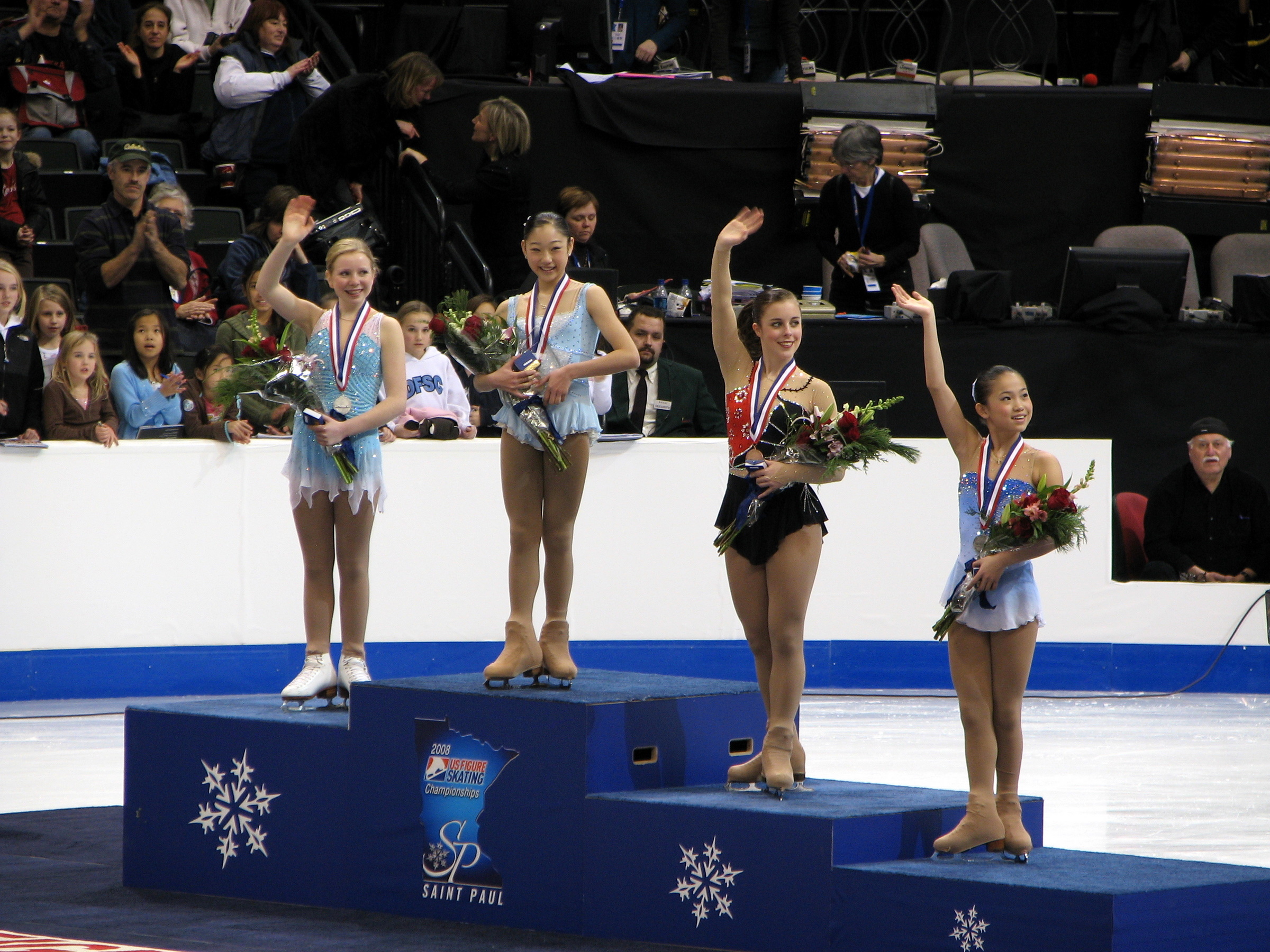
Above: The senior ladies podium from last year's Nationals (from left to right: Rachael Flatt-silver, Mirai Nagasu-gold, Ashley Wagner-bronze, Caroline Zhang-pewter)


Skaters Featured in Part 2:


Beatrisa Liang
Angela Maxwell
Kimmie Meissner
Kristine Musademba
Mirai Nagasu
Ashley Wagner
Caroline Zhang

http://www.iceskatingintnl.com/images/four_continents/2006%204c%20beatrisa%20liang%20sp.jpg
Beatrisa Liang

Noteworthy Results: 2008 Trophee Eric Bombard-5th, 2008 Skate Canada-6th, 2008 World Championships-1oth, 2008 Four Continents Championships-11th, 2008 U.S. Figure Skating Championships-5th, 2007 Nebelhorn Trophy Champion, 2007 U.S. Figure Skating Championships-4th

Pros: Competing in her 11th national championship, and 9th as a senior, Liang is one of the most experienced ladies competing in Cleveland. Liang has four triple jumps in her back pocket (lutz, flip, loop, toe), strong spins, improving flexibility and very creditable speed across the ice. At the recent Trophee Eric Bombard, Liang had seven of her ten non-jump elements marked out of a level 4. Liang only received two downgrades throughout her two Grand Prix events this season (Skate Canada, Trophee Eric Bombard). Liang was able to crack the top 10 at the World Championships last season, a placement that many thought she would be incapable of meeting.

Cons: Liang is notorious for flutzing, and while she did get two of her lutzes marked with an "!" at Skate Canada, she reverted back to her old ways at Trophee Eric Bombard, where she received the more severe "e" deduction on her lutz three out of three times. Liang has been known as a headcase throughout her entire career, examples dating back to the 2006 Nationals where an Olympic berth was legitimately within her grasp when she placed 3rd in the short program. Unfortunately, it didn't become a reality when she dropped to 5th after suffering two falls in the long. Bebe also appears to have stamina issues, as evidenced by her falling on two jump elements, one of them being a relatively simple double axel, after the half-way point of her free skate in Paris. Liang also doesn't have a triple salchow jump, limiting her to a possible six triple jumps in the long instead of seven.

Outlook: Hopefully, Liang enjoyed her time in Gothenburg, Sweden, last March because such an opportunity is unlikely to present itself again. Inconsistency, downgrades, and flutzing have further stunted the potential that Bebe has, which is an unfortunate reality for the very talented skater who was the first U.S. lady ever to successfully complete a triple lutz+triple loop, a combination she is no longer competing. Between this year's Skate Canada and Trophee Eric Bombard, she averaged only 45.64 for program components between the two events in her long program, hardly competitive with the top contenders at this competition. However, one definite plus for Liang is that the last two years she has skated decently at the national championship. While Liang is unlikely to make the world team even at her peak form, she at least won't be forgotten.


http://web.icenetwork.com/images/2008/01/20/KR2p5Ych.jpg
Angela Maxwell

Noteworthy Results: 2008 Junior Grand Prix Final-5th, 2008 JGP Great Britain-3rd, 2008 JGP Ostrava-2nd, 2008 U.S. Figure Skating Championships-2nd (junior), 2007 U.S. Figure Skating Championships (novice)

Pros: A solidly athletic and expressive skater with a very unique long program to the soundtrack of Inuyasha, a Japanese anime, Maxwell will be making her senior debut in Cleveland. She has been witnessed training triple axels (though she said in an Icenetwork article that she's put the jump on hold for the moment), as well as triple lutz+triple toes and triple flip+triple toes. She is currently competing all of the other triples besides the axel. In addition to that, Maxwell is capable of competing a triple flip+double toe and triple salchow+double toe+double loop after the half-way point of her long program. In an era where rotating jumps is ever-important, Maxwell had no downgrades throughout either of her skates at JGPF.

Cons: Maxwell has little experience in comparison with some of her competitors, which showed at the Junior Grand Prix Final. At that competition, Angela suffered three major errors, a fall on her triple lutz in the short, and a single flip and a missed triple flip in the long. These are not the kind of errors that Maxwell can afford to make if she wishes to be competitive for a Grand Prix spot next season. Maxwell was only credited with doing one jump combination for her long program at JGPF. She also simplified the back-end of her planned triple toe+triple toe combination to a double toe and replaced her triple loop with an easier triple toe later on in the program. Maxwell's non-jump elements are in definite need of improvement, with her receiving one level 1 and six level 2s in South Korea. Her PCS marks were only the 4th highest in the long program (44.40), and 6th highest in the short (21.96), and there is no doubt that these marks will have to improve substantially for Maxwell to become a top contender in the U.S. and abroad.

Outlook: Maxwell, who recently made a coaching change from Robin Wagner to Olga Orlova (after originally being coached by Natalia Mishkutenok), has the confidence, content, and artistry to become a contender on the national and possibly international stage, although she is going to have to wait her turn. Maxwell's PCS marks have been less than desirable internationally, and will have to learn and grow from the experience of competing at her first senior competition. While a world team berth is almost out of the question, a top 10 finish is possible for Maxwell in Cleveland. Such a placement could get her onto the junior world team, which would be a first time experience for this self-proclaimed "I'm not into brand names" girl.


http://nbcsportsmedia4.msnbc.com/j/msnbc/Components/Photos/070127/070127_figureSkating_vmed3p.widec.jpg
Kimmie Meissner

Noteworthy Results: 2008 Cup of Russia-8th, 2008 Skate America-8th, 2008 World Championships-7th, 2008 U.S. Figure Skating Championships-7th, 2007 Grand Prix Final-6th, 2007 Skate America Champion, 2007 World Championships-4th, 2007 Four Continents Championships Champion, 2007 U.S. Figure Skating Champion, 2006 World Champion, 2006 Olympics-6th, 2006 U.S. Figure Skating Championships-2nd

Pros: The only U.S. skater to have won a world title since Michelle Kwan in 2003, Kimmie Meissner has proved that she has a burning desire to get back to her top form by moving approximately 1000 miles away from home, living on her own, and temporarily giving up college. An experienced veteran who was a won a medal of every color at the national championship, Meissner is capable of triple-triple combinations and was seen landing triple axels at the practice sessions of last year's World Championship. An elegant short program to "Un Ange Passe" and a dramatic long program to "Concerto Grosso no. 11 in D minor" and "Adagio in G Minor" have expanded the artistic horizons of a skater who has been criticized in the past for her non-existent expression and airplane arms.

Cons: Meissner has gotten wrong-edge deductions in the past for her triple flip (though at Cup of Russia they appeared to be going away). However, one of the real reasons behind Meissner's decline in the standings is downgrades, receiving four of them at Cup of Russia, including a double axel. Meissner was also hammered with low levels on her non-jump elements this season, particularly at Cup of Russia where she received six level 1s throughout the course of the event. Interestingly, Meissner's total score at Cup of Russia was actually lower than at Skate America (131.36 at COR, 135.92 at SA), despite the fact that Meissner's performance was superior to the eye in Moscow than it was in Everett. This is evidenced by the fact that Meissner suffered three falls at Skate America, and had none at Cup of Russia.

Outlook: Meissner's PCS marks have plummeted since her meltdown beginning in December 2007 at the Grand Prix Final, only receiving 25.32 in the short and 48.64 in the long at Cup of Russia. Meissner winning the world title was the best and worst thing that ever happened to her. The best because it gave her publicity, a name to the international skating community, and several miscellaneous opportunities she would not have otherwise had. However, it became the worst thing that ever happened to her career because it caused much more pressure on her and her alone to continue the dominant reign of U.S. ladies in figure skating, with that and iffy jumping technique contributing to her demise. This national championship is really about putting her name back into the hat of possible contenders for the 2010 Olympic team. Realistically speaking, she won't be going to worlds and that shouldn't be of concern to Meissner; been there, done that. While she may not be under pressure for a trip to L.A., she is under pressure here to secure a good finish (preferably top 5), which would allow her to lock up some coveted grand prix assignments next season. If all goes according to plan, she could get herself back into the graces of the international judges to culminate in making the Olympic team a year from now. As for the jumps, Meissner needs to dump her triple-triples immediately in favor of using the triple toe as a solo jump, a double axel+triple toe combination in the long, or an easier triple toe+triple toe. Downgrades are going to be Meissner's biggest nemesis for her quest to go to Vancouver.


The image “http://www.iceskatingintnl.com/images/nationals/us%202007%20musademba%20nlfs%202927.jpg” cannot be displayed, because it contains errors.
Kristine Musademba

Noteworthy Results: 2008 Junior Grand Prix Final-6th, 2008 JGP Courchevel Champion, 2008 JGP Madrid Champion, 2008 U.S. Figure Skating Championships-4th (junior), 2007 Junior Grand Prix Final-4th

Pros: Musademba, another skater who is making her first appearance on the senior level in Cleveland, has had a solid start to her year, placing 1st at both of her junior Grand Prix assignments and placing 6th in the final. Musademba has five triple jumps that she is currently competing (all except the axel) and has been credited with taking off of the correct edge for both her flip and lutz. Musademba also beat Becky Bereswill at the Junior Grand Prix Courchevel this year, and also received three level 4s for her non-jump elements at JGPF.

Cons: Musademba had a shaky outing at the Junior Grand Prix final, placing eighth out of eight skaters after the short before moving up to sixth after the long. After suffering a fall on her triple flip in the short and later going on to under rotate her triple lutz, Kristine under rotated two jumps in the long and had a very awkward fall on a double toe loop. While Kristine skated nervously in South Korea, even when she does put it together her scoring potential is nothing to drop your jaw over, receiving a mere 89.84 for a program with five cleanly hit triples at the Junior Grand Prix Courchevel. Musademba's PCS marks were the 2nd-lowest at the Junior Grand Prix Final in the long program (41.76).

Outlook: Musademba has a legitimate shot at making the top 10 at Nationals and while making the world team is a virtual impossibility, a trip to junior worlds would be great experience for the 16-year-old from Washington, D.C. If she wishes to become a top-rate skater, Musademba will need to work on the artistic components of her skating, especially musicality and flow. And of course improving the consistency of her jumps and avoiding downgrades will be key as well. Musademba could get on NBC's last nerve, however, if she is to take Emily Hughes' spot as one of the top 10 skaters after the short program that will be broadcast in the free.


http://www.japantimes.co.jp/images/photos2007/sp20071014a1b.jpg
Mirai Nagasu

Noteworthy Results: 2008 NHK Trophy-8th, 2008 Skate Canada-5th, 2008 World Junior Championships-3rd, 2008 U.S. Figure Skating Champion, 2007 Junior Grand Prix Final Champion, 2007 World Junior Chamionships-2nd, 2007 U.S. National Champion (junior)

Pros: During the last two years Nagasu has peaked at the national championship, upsetting favorite Caroline Zhang to win the junior title in 2007 and the senior title in 2008. Nagasu won last year's event despite under rotating a the back-end of a triple lutz-triple toe combination in her long program, as well as suffering a fall on a double axel. Her short program score at last year's junior worlds (65.07) has only been surpassed by two skaters this season (Yu-Na Kim, Mao Asada), and that was with a wrong-edge deduction on her triple lutz. Nagasu's scores are aided by her non-jump elements, including her spins and spirals which showcase astounding flexibility. Nagasu received the highest program component scores of all the ladies in both programs at last year's Nationals.

Cons: Nagasu has had a grand total of 13 jumps downgraded thus far this season, and some of them were double jumps as well. Nagasu has struggled with fully-rotating jumps in the past, and having grown to the height of 5'1'' has not helped her out in the least. There were past rumors that the Japanese Skating Federation was trying to court Nagasu into skating for Japan, but any such hopes of JSF doing so went straight to the grave when Nagasu finished 8th at the NHK Trophy in Tokyo, not being credited with landing a single triple jump throughout the entire competition. Nagasu also had three non-jump elements that were below a level 3 at that particular event. She also appeared to have stamina issues at both competitions, further evidenced by her falling on her footwork in the long program at this year's Skate America.

Outlook: If Nagasu were to put it all together like she did when winning the 2008 U.S. Figure Skating Championships, she could actually be U.S.A.'s best hope of a ladies medal in Vancouver, and that includes Sasha Cohen. Nagasu has all the ingredients: spins, spirals, artistry, skating skills, and speed, but those jumps have to be consistently landed and consistently rotated in order for Nagasu to stand a chance internationally. Nagasu's PCS marks weren't overly dreadful at NHK, which means that the judges still appreciate her talent. Citing that jumps are Nagasu's big issue, many have suggested that it would be wise to leave her coach, Charlene Wong, and go to a coach who specializes in jumps. Rafael Artunian, Richard Callaghan, and Brian Orser are some possible "jump doctors" that could help Nagasu with her under rotations and her consistency. However, it is unclear whether such a change is at all likely to happen, as Nagasu seems pretty comfortably situated with Charlene Wong, and her parents are reliant on running their restaurant in order to make a living. As for this championship, there are many unknown factors regarding Nagasu's potential placement. How much Nagasu has improved from NHK is unknown, and there is also the factor of a lenient caller who will be less likely to downgrade Nagasu's jumps, thus providing her with an unfair advantage. While she may have the most potential of all the U.S. girls, Mirai shouldn't be stepping foot on the ice in L.A. or Vancouver until she has proven that she can rotate her jumps consistently, and with authority.


http://cache.daylife.com/imageserve/0bmYf3i3061S6/610x.jpg
Ashley Wagner

Noteworthy Results: 2008 NHK Trophy-4th, 2008 Cup of China-4th, 2008 World Figure Skating Championships-16th, 2008 Four Continents Championships-8th, 2008 U.S. Figure Skating Championships-3rd, 2007 Trophee Eric Bombard-3rd, 2007 World Junior Championships-3rd, 2007 U.S. Figure Skating Championships-3rd (junior)

Pros: Wagner is one of only five skaters to have broken 60 in the short program thus far this season in international competition. Ashley has competed triple lutz+triple loops before, and gave the strongest performance of her career thus far at last year's nationals. Wagner, now coached by Priscilla Hill, has wisely rearranged the jumping layout for the long program in such a way to allow her to do seven triples without risking a triple-triple or doing the lutz twice, as she has gotten several wrong-edge deductions on her lutz in the past. Wagner has demonstrated solid improvement in her artistry this season, with a romantic short to "Somewhere in Time" and a dramatic, powerful long to "Spartacus." This has been reflected in her program component scores, with Wagner receiving a 54.56 in the long program at NHK, the highest PCS marks awarded in a long program this season for an American lady.

Cons: Wagner is a chronic flutzer, the only time where she didn't receive an "e" deduction at a major international meet was during the short at this year's NHK, where she still received an "!" Wagner has been prone to getting deducted for under rotating her triples, getting downgraded for two at NHK and one at Cup of China earlier this season. Wagner has yet to show a triple-triple this year and had three errors on her jumps in the long at NHK, causing some to think that her artistic improvement has come at the expense of her maintaining the solidity and consistency of her triple jumps. Wagner's seasons best in the long has been surpassed by Alissa Czisny, Rachael Flatt, and Caroline Zhang thus far this season.

Outlook: Unless if her triple-triples start becoming incredibly consistent, Wagner will probably be wise to stick to doing a triple-double in the short, as her short has proven to have very high scoring potential already. One has to remember that part of the reason of Wagner's relatively shaky long at NHK likely had a bit to do with her rearranging the program so much between Cup of China and NHK. Wagner's seasons best is the second highest among the ladies competing in Cleveland (behind Flatt), and her program components average this season in the long (52.32) is the highest of all the U.S. ladies, including Czisny. Wagner was scored suspiciously high at last year's Nationals, especially looking at the protocols where she did not receive a single wrong-edge deduction. With all of this criteria considered, it seems logical to predict that Wagner has a very respectable chance at going to Los Angeles, although USFSA might be wary to send her after her weak showing last year.


http://web.icenetwork.com/images/2008/02/25/fLwX86h2.jpg
Caroline Zhang

Noteworthy Results: 2008 Trophee Eric Bombard-3rd, 2008 Skate Canada-5th, 2008 World Junior Championships-2nd, 2008 U.S. Figure Skating Championships-4th, 2007 Grand Prix Final-4th, 2007 Cup of China-2nd, 2007 Skate America-3rd, 2007 World Junior Figure Skating Champion, 2006 Junior Grand Prix Final Champion

Pros: Coached by Ming Zhu Li, a past coach of former world champion Lu Chen, Zhang is a tough competitor and a very talented young skater. Zhang's assets include having triple flip+triple toes in her arsenal for both programs, good consistency, and practically inhumane flexibility. Her signature "pearl spin" is a hotbed for +2 and +3 GOEs, and it is easy as 1+1=2 to recognize that Zhang is a ruthless perfectionist, as evidenced by almost every competition article where she is always quick to point out what she wishes to improve upon.

Cons: Unfortunately, just because Zhang is a perfectionist doesn't mean that her skating is without obvious flaws. First off, she has been criticized for her "mule kick" technique into her lutz and flip, as well as her flutzing her lutz, which still received an "e" wrong-edge deduction during the free skate at Trophee Eric Bombard. The flutz has required Zhang to reinstate a less valuable triple salchow into her long program, and put a triple loop into her short program. Like Nagasu, Zhang had a growth spurt over the summer, growing to the height of 5'2". Zhang got downgraded on both the front-end and back-end of her triple-triple in the long at Trophee Eric Bombard, as well as the back-end of that same jumping pass in the short. Zhang is also weak when it comes to speed and skating skills, and her program component marks are reflecting that. Her PCS average in the long this season is actually lower than that of Nagasu and Meissner.

Outlook: While Zhang is a competitor, she has some serious technique issues that if not addressed will certainly have a negative impact on her overall skating in the future. Zhang has fallen short of expectations and skated below her best at the last two national championships, and has been receiving lower PCS marks and downgrades this season. Also noteworthy is that Zhang placed lower than Nagasu during the long last year at Nationals, where Zhang essentially skated the best she could and Nagasu had one fall, one downgrade, and one wrong-edge deduction on her lutz that she isn't as prone to getting as Zhang. Many are putting Zhang up against Wagner for the second ticket to L.A. (assuming Flatt wins), and it really seems as though Wagner has the advantage over Zhang in more ways than one. However, it is worth mentioning that Zhang's personal bests in the short (62.40) and the long (114.66) are higher than those of Wagner or even Flatt, and if she were to get to the level she was at where she placed 4th at the Junior Grand Prix Final last season, Caroline would be a shoo-in to go.


Podium Prediction

Gold: Rachael Flatt-Consistent as all get out, rotates her jumps, and performed brilliantly last year. A recent video of her performing her short program at a judges' critiquing session at Broadmoor Skating Club shows Flatt to be looking very fit and confident.

Silver: Ashley Wagner-Has improved artistically and hopefully can get it together technically. Peaked at nationals last year and was scored very well, and with the international judges warming up to her she seems like a logical girl to send to Worlds.

Bronze: Caroline Zhang-Has had issues at Nationals in the past and could receive substantial deductions for under rotations and flutzing, but is a first-rate competitor who one can never count out.

4th/Pewter: Alissa Czisny-Has been inconsistent and the same is true for her history at Nationals, but she has made improvements in her jumping technique this season and has all the other ingredients for a great skate and big marks.

5th: Mirai Nagasu-A Japanese article after her long at NHK mentioned how disappointed and angry Nagasu was with her performance in Japan; if history means anything she'll do very well in Cleveland, but hopefully USFSA has the message that a strict caller is necessary for the championship and that Nagasu getting away with downgrades could prove to be disastrous if she goes to Worlds.

6th: Kimmie Meissner-Surely will have improved from the Grand Prix series and will have very little pressure on her to do well. Likely won't be at the form she was when she won her world, four continents and national titles, however.

7th: Beatrisa Liang-Generally skates decently at Nationals, and has far more experience than some of the younger skaters coming up.

8th: Becky Bereswill-With decent artistry and decent jumps, Becky would like to improve from her 10th place finish from last year.

9th: Alexe Gilles-Elegant skater with solid jumps, has polishing to do and more experience to gain.

10th: Katrina Hacker-Beautiful skater but doesn't have the content to contend for the higher placements; I wish her all the best if this is indeed her swan song.

Predictions for World Team: Rachael Flatt, Ashley Wagner
Predictions for Four Continents Team: Rachael Flatt, Ashley Wagner, Caroline Zhang
Predictions for Junior World Team: Becky Bereswill, Alexe Gilles, Angela Maxwell


That is all.